

With a cast of characters that includes Death, The Dead, and a ghost named Magdalene who believes she’s still alive,Maureen Alsop’s Today Yesterday After My Death is a conceptually ambitious book—and, like an elite gymnast, Alsop lands all the difficult moves.
The book is technically a hybrid novel—partly written in verse, partly in prose—but I would call it a novel in verse, for, while little of it is lineated like poetry, the exquisitely crafted and highly imagistic language in every paragraph read like a prose poem. Moreover, verse is the only literary form spacious and muscular enough to carry this riveting narrative through to the end. Alsop’s graceful language and vivid imagery invite readers to weave their own life experiences into those of the characters, creating a rich collaboration in the meaning-making experience: a personal experience I’ll elaborate on at the end of the review.
Page one features the illustration of a quirky planetary phenomenon that forms the physical and metaphysical foundation for the narrative: a solar analemma. This is an infinity loop of light that, due to Earth’s axial tilt and elliptical orbit, represents the true path the sun takes through the sky. It’s visible only if photographed every day from the same location over the period of a year—otherwise we’re left clinging to the erroneous belief that the sun rises in the east and follows a direct course across the sky until it sets in the west.
Western and Eastern cultures alike correlate solar energy with the masculine archetype— conscious, direct, and real; and lunar energy with the feminine archetype—unconscious, looping, and illusory. By illuminating the world of her novel with an analemmic sun, Alsop blurs these boundaries, creating a textual space capacious enough for her protagonist, Magdalene to “live” and write from an all-encompassing solar-analemma consciousness:
There is an insular rule which slips her back into the loop—
just as the sun rose, and just as the sun set, the infinity returns
them to the same position.
Everything came into view. The world asleep; no light of
the old traditions within it now. The earth above. Wordless.
Magdalene dropped formalities. You both dropped through
atmospheric miles. She touched the shape within the light
which excised each darkness. You woke the bell. And you
ended the bell. You died under the ringing.
Page one’s analemma illustration features five war-related star points: World War I; World War II; the fractious Byzantine Empire; the French and Indian War’s Battle of the Plains of Abraham; and Bourbaki’s Panorama, an in-the-round painting depicting a scene at the end of the Franco-Prussian War. Most scenes in the book take place during these specific wars, however, the analemmic sweep through which these wars cycle reminds us that the sun’s every pass across the sky, over the whole of human history, has born witness to wars playing out somewhere on the surface of the Earth. Magdalene experiences this sweep visually and viscerally when, for example: “She heard their [The Dead’s] breath, particles caught in her throat, the last battle of the First Crusade, a few molecules surfacing centuries later mingled with the firebombs, the future’s kill space.” She records these experiences, along with events to which she bears witness, in a ledger that she carries with her throughout the novel, “A ledger into which she impresses the balance of action from one battle through the next.” This keeps her busy, as mankind is a warring species.
I use the oxymoron, “mankind,” intentionally, for human history has largely been defined by war, and war has always been the purview of men. I’d like to think history curriculums have changed since my schooldays, but for my generation and many before me, learning history meant lurching from one war to the next, memorizing dates, battles, factions, and generals. And I always wondered (but was never brave enough to ask my teachers): other than Betsy Ross, Florence Nightingale, and Rosie the Riveter, where were the women? It’s a question Magdalene ponders when looking at a picture of a busy town square during The Great Retreat of 1914 where “Rows of horses and men lower among the lingering dust, crowded among packs and munitions. The streets and shops closed.” This leads her to draw the only logical conclusion: “Magdalene stares at this photo and thinks how the women did not exist. The women did not exist.”
It is a conclusion also informed by her first-hand experience. During one of the many wars that advanced the Byzantine Empire, we’re told that “the other prisoners watched her being pulled by her hair and tossed into a cell with overflowing sewage…. The weight stripped off her; all along she knew justice wouldn’t arrive. She was a single pixel in the entire field of view. Her succour, her sorrow.” Even when she actually exists among them, she remains unseen. Even when others witness brutal attacks against her, ever the “ghost,” she remains unseen.
Every war requires the sound of a plural diction.
The psychology of war is complex, and the soldiers tasked to carry out atrocities orchestrated by their leaders often suffer a tragic loss to their humanity and their very perception of reality. In World War II, we’re told, “The soldier did not kill a person. He murdered an idea.” In the Byzantine era, the narrator tells us, “The armies retained a place within the realms of the holy. They never saw the damage,” later telling the soldiers themselves that “The revolution you were a part of became your identity, and within days, a language, the charges of a passionate new belief…. Every war requires the sound of a plural diction.”
Alsop reminds us, though, that the mandated diction which feeds the ongoing war machine is not the only “plural diction.” There is a much more powerful one—one that must be willingly embraced in order to be “spoken”: It is the silence of nature that flows, grows, greens, and blooms throughout the novel.
At one point, Magdalene takes up her ledger to pen a passage to her lover, an unnamed soldier:
My prayers are stitches in your
sweat-stained garments. But I held you. And when I held you,
I could see the mind’s two chambers were a thousand lives,
a neuropathy of consciousness in complete and unending.
… To say the nation’s men drown in cigarette butts,
is to say their flushed faces were purple capillaries strewn
across the grass. These fields, once a theatre of running bodies,
are now dunes of poppies asleep mid-blossom. A tapestry of
April’s red lovers.
The image of these red poppies returned me, in true analemma fashion, to an alpine meadow I once visited in Kobarid, Slovenia. It was the site of a World War I battle that decimated Italian troops, many of whom died with tomatoes from home in their pockets. These tomatoes sank with soldiers’ flesh into the soil and self-seeded, transforming the battlefield into a meadow alive with wild Roma tomatoes every summer since.
Nature’s diction is not without death, but its life-death cycle follows a natural rhythm whose beat pumps blood through every earthly body; whose sky traces the invisible path of the sun. Nature herself floods our bodies with the very life that wars repeatedly rip away. Cold comfort, perhaps, but Today Yesterday After My Death is nothing if not truth told from the perspective of the source of life itself—the sun, which has seen it all—and the truth it tells could not be more timely: when Alsop’s narrator unflinchingly notes that “Being human requires living in terror,” she speaks not only to centuries past but also to the present moment. A moment of full-scale foreign invasions and widespread genocide, where once-respected democratic nations are invading their own cities and waging war on their own people. Such atrocities may be coming as a shock to many of us, but from the ageless narrator’s perspective, it is simply status quo—and does not diminish even the most minute of our quotidian concerns or the beauty of nature’s most humble miracles, as we see in the book’s closing lines:
in the end you asked where your glasses with the bent frames
went, the chirp of the walls were the minute, it was the un-
going, what was alone, grevillea’s dappled needling,
all that you needed in the acreage,
you gave way, sprays of rockweed, milksap
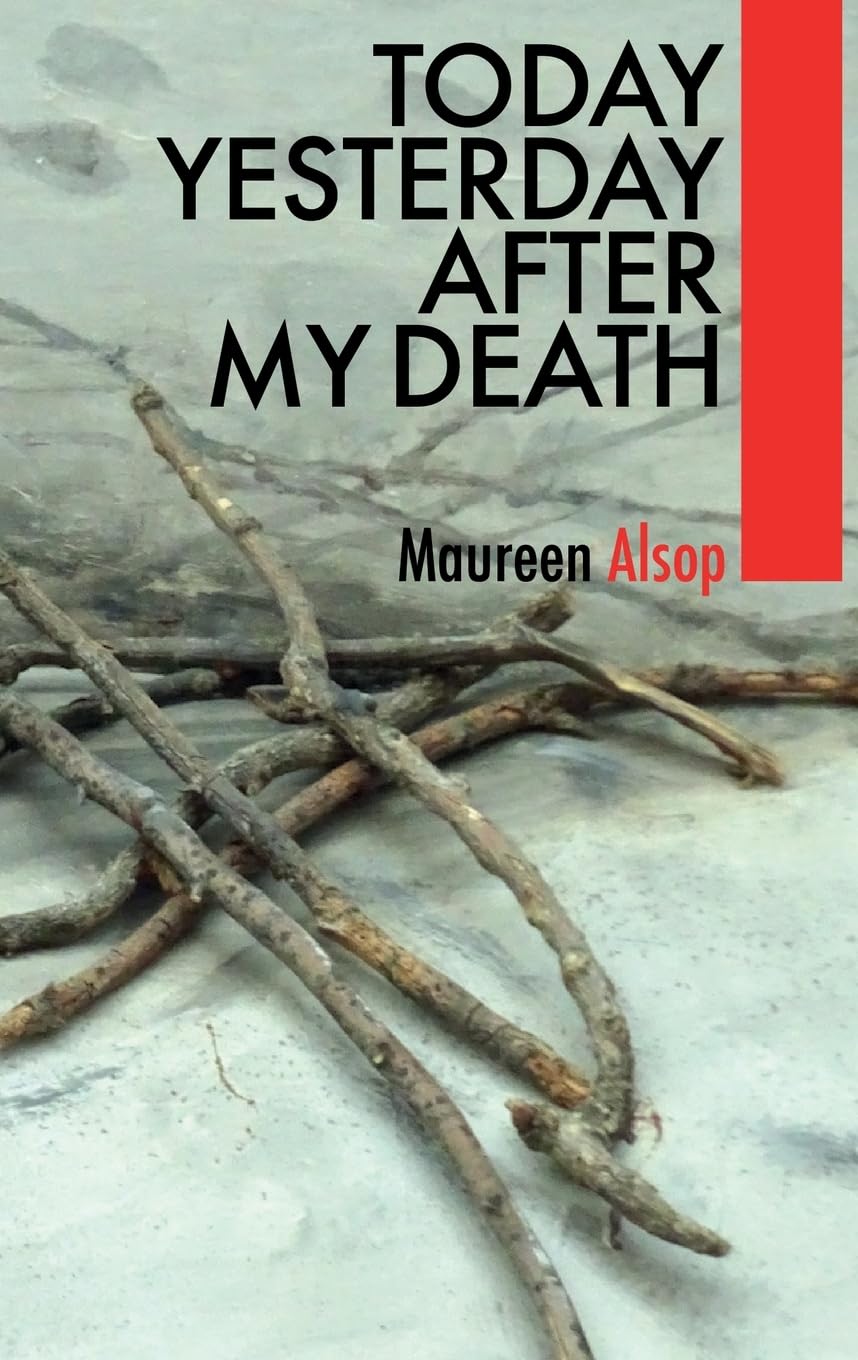
Maureen Alsop is a psychologist, writer and artist; she is the author of a debut novel, Today Yesterday After My Death (Erratum Press, 2024), and seven poetry collections, most recently, Arbor Vitae (Nauset Press, 2023). Her visual poetry and visual artworks have appeared at Umbrella Studio, Mezzo Cammin, and Studio One, 40. Her translations of the poetry of Juana de Ibarbourou (Uruguay, 1892-1979) are found through Poetry Salzburg Review.
Christina Cook is the author of two books: a speculative non-fiction book of poetry, prose, and translation titled Roaming the Labyrinth with Marie-Claire Bancquart (AIM Higher Press, 2025) and the poetry collection, A Strange Insomnia (Aldrich Press, 2016). Her poems, essays, book reviews, novel excerpts, and translations have appeared widely in journals such as the New England Review, New Ohio Review, and Prairie Schooner. A former speechwriter and writing professor, she lives in San Diego, CA.

