

…perhaps you can imagine Woolf walking down to the Ouse. She puts stones in her pockets. She sits on a large rock looking out at the water. She does not take the stones from her pockets and walk back to the house; she does not walk into the water. It could go either way.
Perhaps you can imagine Helen DeWitt at Niagara Falls or on a cliff near Brighton. It could go either way.
Lotteryland. Book within the book, YOUR NAME HERE.
A preoccupation with the aleatory in the author’s oeuvre.
Cage. Burroughs. Mallarmé.
[I originally mistranscribed the opening quote as “She puts stones in her packers.” Cognitively predisposed by an earlier allusion to the Green Bay Packers in YOUR NAME HERE. I don’t recall what the Green Bay Packers have to do with anything, but it gives you an idea of the sort of randomization at play. You may be trying to decipher an allusion to Deleuze & Guattari, for instance, when they suddenly morph into Wilder & Pryor–in Brewster’s Millions.]
Terry Gilliam on Fellini’s 8 ½:
It’s all moving, it’s shifting. Things are coming in and out of frame. It’s never still. It’s what life always seems like to me.
Who the hell is Ilya Gridneff? You’ll want to know.
You’re gambling with no cards in your hand.
He is the next Hunter S. Thompson, it turns out. A real “character”.
It’s his cleverness and canniness and wheelerdealerness that she loves. (his: Odysseus’, she: Athena)
A preoccupation with transgression in the author’s oeuvre. Sex workers in particular. Apropos of which, reviewer begins to wonder if the author is a sex worker? And means is authorship a kind of sex work? Not is Helen DeWitt a sex worker? The latter being a sketchy proposition for a book review, but seems a non-zero probability with the author in question.
Or is authorship akin to game design?
When it was fun vs. realism, fun won.
Author of Lotteryland (book within the book), Rachel Zozanian (avatar of DeWitt) expresses the desire to discover in manuscript (or in life) something/someone who/which has yet to be published (encountered). A longing for the raw in an overcooked world.
Enter Ilya Gridneff. A real “character”.
For what “character” is worth. And perhaps Ilya is merely a projection of DeWitt/Zozanian’s desire. His being an actual person (à la Emmanuel Carrère’s Limonov) with a colorful back story and Rabelaisian email style notwithstanding.
And agents and publishers are pimps?
…now the real pregnant poignant dormant lacunae…springs itself back to the fore front [sic]. Money.
The Invisible Hand.
diegetic silence-over
A preoccupation with language(s) in the oeuvre. The author knows 14 of them at last count.
Typesetting foreign languages being a bane of her existence.
You can learn a bit of Arabic in YOUR NAME HERE. It will be more useful to you than any of the Elvish languages you might have learned in the works of J.R.R. Tolkien.
The sort of book (Zozanian/DeWitt notes) that would have been useful to the CIA in their War on Terror.
Said War being waged as backdrop to narrative events.
(The aughts.)
Britney Spears. Tom Cruise. L. Ron Hubbard. Gaza (then). Charlie Kaufman. Dick Cheney.
It could go either way.
In one passage there is an allusion to Who Framed Roger Rabbit?
(Actors were unsure where to direct their gaze/gestures.)
facsimile of Kim Basinger as a reasonable facsimile of Veronica Lake in LA Confidential
There is an account of pubic hair fly-fishing in one passage.
You’re on page 446 and you still have no idea what’s going on…in other words, the book is fucked.
Presuming you’ve made it to page 446. Perhaps you are a Helen DeWitt completist.
But wait. It may not be too late.
Has reviewer chosen this fragmentary form to obviate explication? To conceal his imperfect understanding of what the author is trying to say?
(For what authorial intent is worth.)
Hustlers
Pynchon. Gaddis. Delillo.
Kathy Acker. Jean Genet. Michel Houellebecq. Laurie Anderson.
Aren’t omniscient narrators passé?
Tristram Shandy. Hopscotch. Infinite Jest.
Adorno. Adorno. Adorno.
Gridneff has blackouts. Lived experience lacunae.
…is the opaque device with minimal explanation the motivating force behind all great work/s?
Who the hell is Ilya Gridneff?
The second person.
Does the reader have blackouts while reading YOUR NAME HERE?
Maybe you’re not into this sort of heavy meta- headbanging.
Instead of the wealth of stories you loved in the last book there are narrative strands which you find hard to follow.
Some Tricks
Reviewer presumed he’d only appetized the author’s oeuvre, but comes to find he has already devoured it. How many unpublished manuscripts is Helen DeWitt in possession of? Intimations thereof in YOUR NAME HERE (& interviews).
The withheld work of art is the only eloquence left. Delillo suggests in Mao II.
The protagonist of Lotteryland is made to leave a café because of negative facial expressions.
The MacGuffin. Chekhov’s gun. Plot vouchers. Unexposed contents.
…not sure about the relentless sexualisation of the narrative…
You can gauge your luck on a lottomonitor. In Lotteryland.
Rachel Zozanian has a “phobia of the spoken word”. Entreats friends and associates to put it in writing.
Wilde’s Bunburyism.
Lily Marlowe was unavailable for comment.
Lottomonitor results for: Firm resolve. Ecstasy. Appearance of sincerity.
You don’t choose your parents. Luck of the draw. Ludo never makes his peace with in The Last Samurai.
I must have thought I could step into the floating world.
Hard to say whether you, dear reader (unacquainted as I am with your back story, proclivities, sensibilities, erudition, attention span, etc.), will lose yourself into the labyrinth of YOUR NAME HERE or retrace your steps back to (a more accessible version of) reality before you reach page 446.
[X likes songs that gesture at inarticulacy.]
It could go either way.
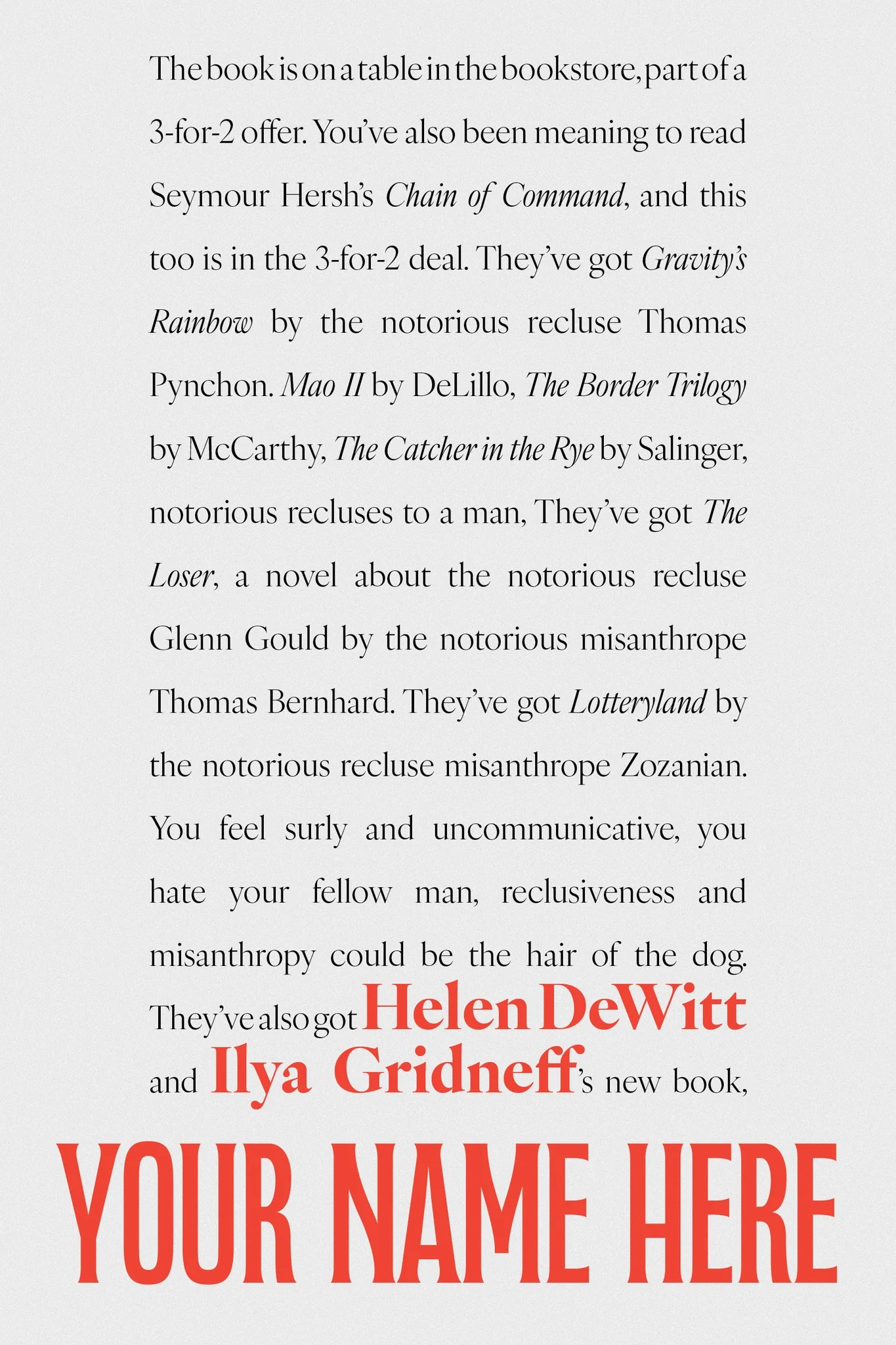
Helen DeWitt is the author of The Last Samurai, which has been named one of the best books of the 21st century by multiple publications. She is also the author of Lightning Rods, as well as a collection of short stories, Some Trick, and a novella, The English Understand Wool. She lives in Berlin. YOUR NAME HERE has been published by Dalkey Archive.
Ilya Gridneff is a Toronto-based journalist working for the Financial Times. Over the years he has written articles for the Baffler, Vice, the Guardian, the Sydney Morning Herald and Foreign Policy. He has lived and worked in Somalia, Kenya, South Sudan, Papua New Guinea, London and Berlin.
[name of author] lives in [major metropolitan area] where he [academic post, marital/family status and/or wry biographical tidbit]. He is the author of [titles] and his work appears in [various periodicals].
 minor literature[s]