

I. GARDEN EXTERIOR DAY
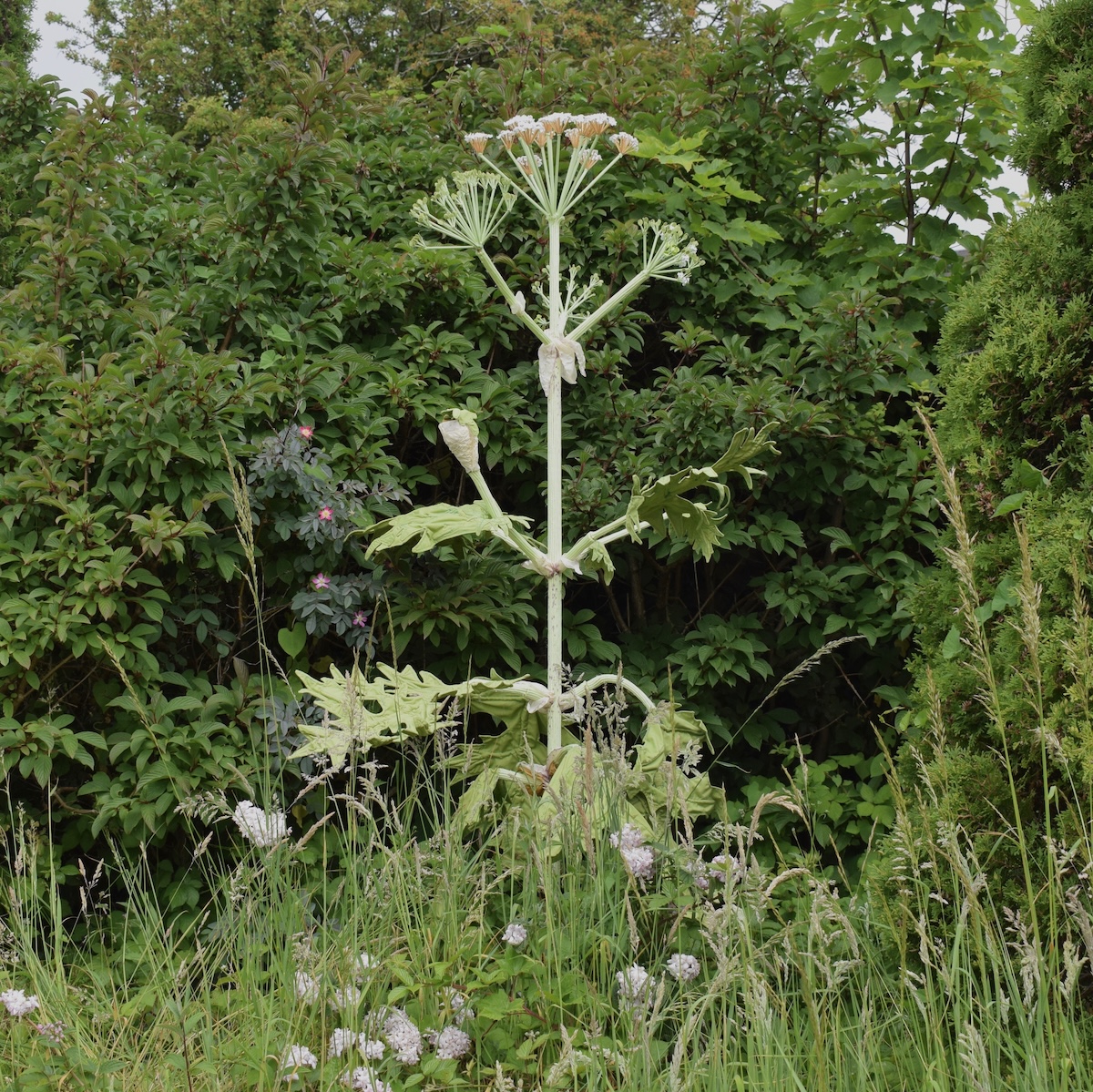
Stems, three-metre high, supported the huge umbels studded with flies and various beetles (later, in my garden I observed chafers in abundance, colourful long-horned beetles, hundreds of Diptera and some butterflies.) The hogweed flower – actually a vast inflorescence – that day was receiving. The court and the city of Entomofauna met there; such was my impression. *
From their 1890 botanical and anthropological expedition to the Caucasus, two botanists from Florence, Stephen Sommier and Emile Levier, brought back, among the 1,627 varieties of plants whose seeds they collected, the giant hogweed. It was named, following the binomial nomenclature devised by Carl Linnaeus in the eighteenth century, Heracleum mantegazzianum. The genus of the plant, Heracleum, after the Greek hero Heracles, includes species of hogweed and cow parsnip, and Mantegazzianum was to honour Paolo Mantegazza, an Italian anthropologist and common friend of the two explorers – incidentally, Mantegazza had interesting ideas about the potential uses of coca leaves and some less so about the superiority of the Aryan race.
It was the Swiss horticulturist Henry Correvon who described the growth of the giant hogweed; it took him two years to germinate the seeds and five to see the first flowering. Depending on external conditions, the plant grows to maturity in three to five years, reaching up to five metres, producing thousands of small white flowers arranged in wide umbels, which then seed and the plant dies to be reborn elsewhere. The giant hogweed accommodated itself easily to a variety of climate and soil conditions and soon the plant, first encountered at 1,800 metres above sea level by Sommier and Levier on the 26th of August 1890 in the gorge of the river Klich in Abkhazia, could be found throughout the gardens of western Europe where it was greatly appreciated as an ornamental plant.
II. STUDIO INTERIOR DAY
The plant surprises by its posture. The most serious descriptions speak of an ‘architectural and grandiose carriage’.*
Upon its arrival in Europe the giant hogweed quickly caught the eyes of artists. Louis Guingot, a French painter and founding member of the Art Nouveau movement in France, l’École de Nancy, was given some seeds at his wedding. The sculptural qualities of the plant were an ongoing source of inspiration for the decorative works of the school.
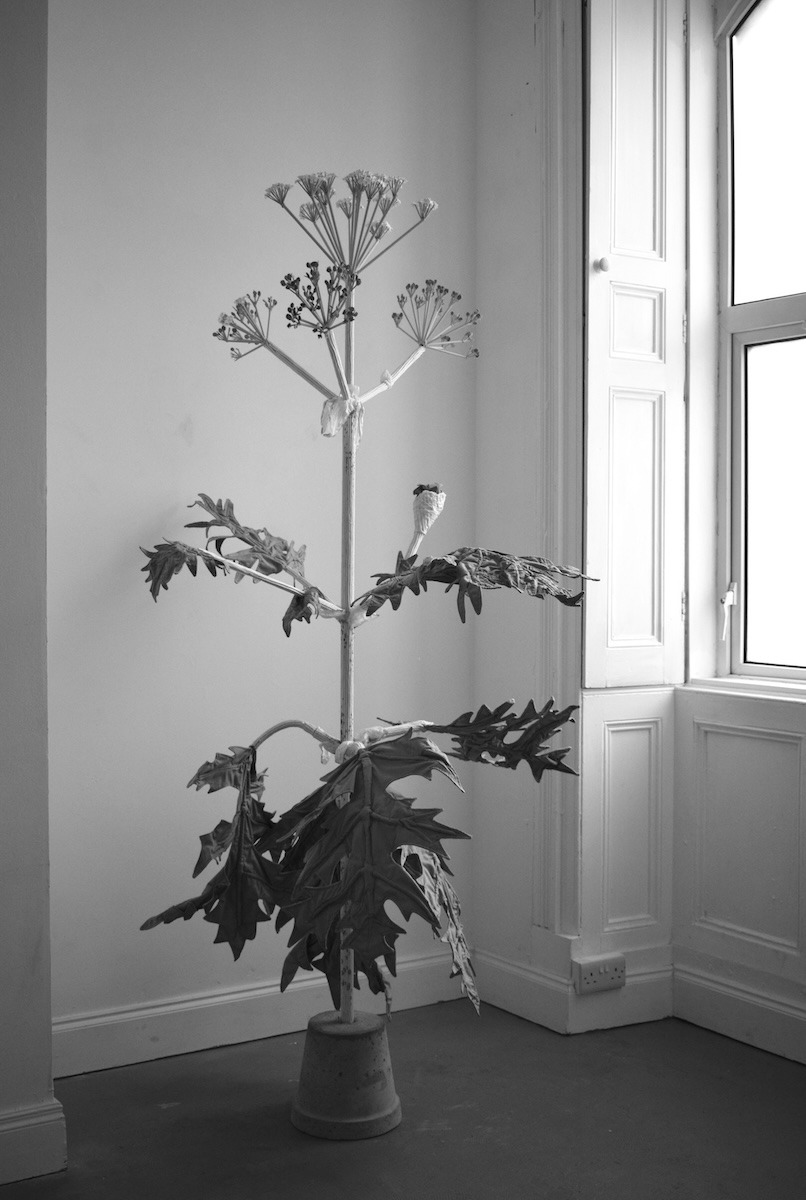
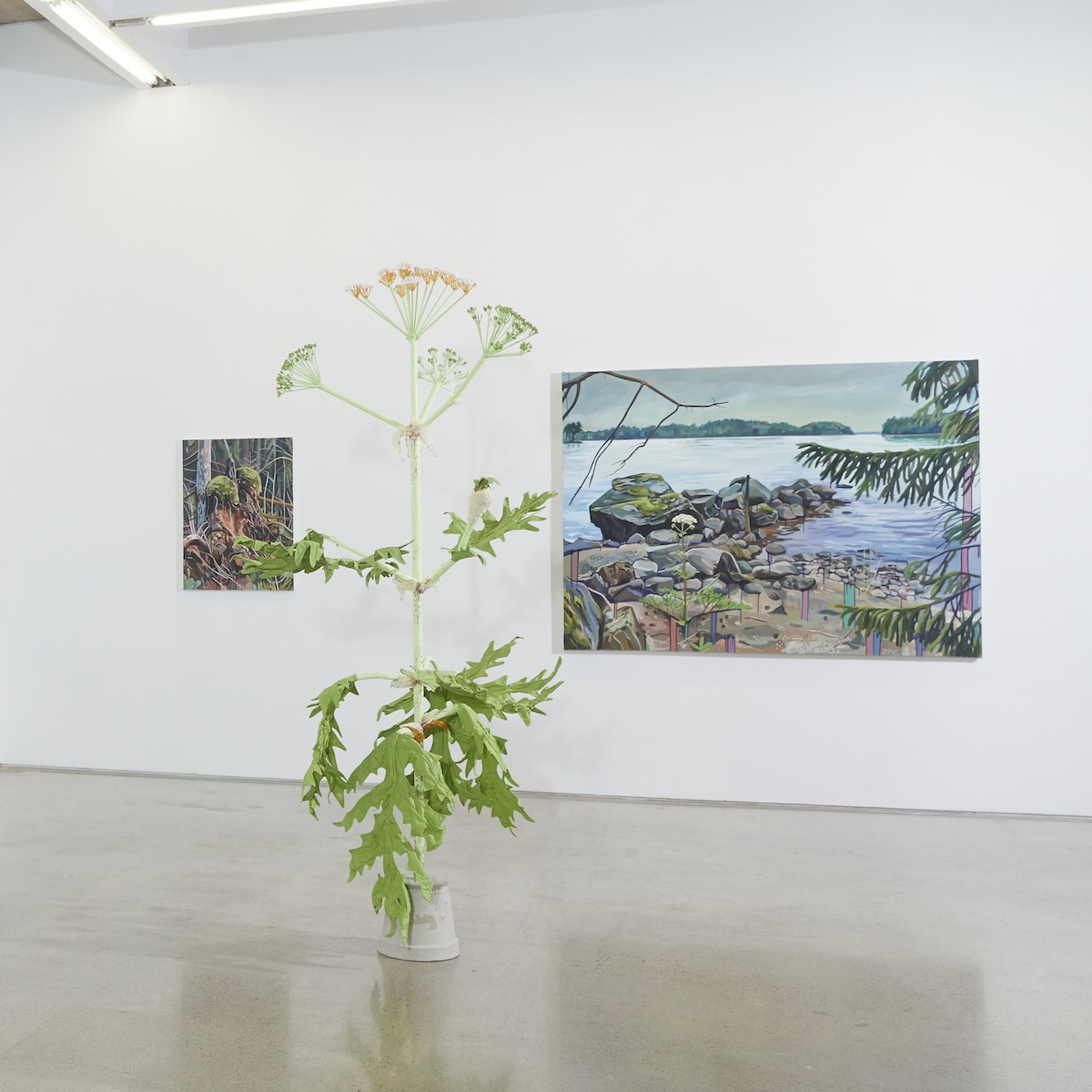
Cecilia Danell’s Giant Hogweed (2020) made its first public appearance at the Kevin Kavanagh Gallery in Dublin as part of her solo exhibition I Set a Bait for the Unknown. Through her paintings of the Scandinavian forest, the artist has constantly probed the nature of authenticity and the degree to which the idea of wilderness is constructed.. In these images, the distinctive shapes of giant hogweeds and wild angelicas are recurring motifs, so that her sculpture, when positioned alongside the paintings, appears like a three dimensional manifestation of them.
Giant Hogweed stands two metres tall, a dowel structure rooted in an upside down bucket cast in concrete. The stout, ridged stem iswrapped in pale green rope glued together and splashed with blotches of purple paint.. The nodes are sheathed in white silk with further purple stains, from which the leaf stalks branch out. The leaves are cut from cotton fabric and sewn along the petioles and stipules which are articulated by hidden wires. The sculpture culminates in four compounded umbels at different stages of flowering and seeding: the rays of the cluster are made of wooden sticks painted green, each supporting smaller rays made of orange matches and topped with small cut out pieces of white fabric to figure its inflorescence.

III. STUDIO INTERIOR NIGHT
To be burned by giant hogweeds, we need to proceed to an ‘exchange of fluids’: first we must sweat, then get in contact with the sap, and finally expose ourselves to the sun. June is the recommended month. Lesions appear within the hour. Recovery takes a little under a month.*
A quick internet search for the term ‘giant hogweed’ immediately turns up multiple articles with alarmingly militaristic headlines: ‘toxic invaders’, ‘most dangerous plant’, ‘drones used to target giant hogweeds’, ‘how to identify and kill’. The plant is simply ‘nasty’. It is classified as one of the dreaded Alien Invasive Species (IAS) and figures in many countries’ national invasive species lists as a matter of biosecurity. It endangers native biodiversity.
In her essay ‘The Aliens in Our Midst’, biologist and social scientist Banu Subramaniam points out that the distinction between alien/exotic plants and native ones is not as easy as these lists make it appear because biological processes are never static. She also remarks on the parallels between the characteristics attributed to human aliens and exotic plants: both are routinely described as aggressive, uncontrollable, prolific, invasive and expanding. And for either issue, borders and fences are proposed as solutions of choice.
IV. GALLERY INTERIOR DAY
For my part, I hold the plant in great esteem. No other species can compete to form and distort space, create depths or erase them for a season, change the scale of perception, but also animate the garden, welcome insects, create, in a short time span, in a cramped space, a little enchanted landscape to be looked at on tiptoes.*
Gardener and philosopher Gilles Clément likes wanderers. His book, Éloge des Vagabondes (In Praise of Vagabonds), opens with: “Plants travel. They move about as quietly as the wind. We can’t do much about the wind.” Among these wanderers, the giant hogweed occupies a special place in his herbarium. They inspired the concept of the garden in movement: it was from the shifting position of the plants in the garden that he developed the notion of a garden that moves with the plants, managing their movement. He often speaks of landscape designers as being like architects, more preoccupied by form than the living species they work with. This is why Clement prefers the term ‘gardener’for himself. The garden in movement works with plants and is constantly changing, it makes space for the unwanted and works with the unexpected.
Another of Clément’s concepts is The Planetary Garden, which, acknowledging the limits of our world and the omnipresence of humans, proposes that we think of the planet as a garden.
***
*Gilles Clément, Éloge des Vagabondes, 2002, my translation.
Giant Hogweed – rope, fabric, dowels, concrete, string, 210x75x70 cm, 2020. Exhibited as part of the exhibition I set a Bait for the Unknown at Kevin Kavanagh, Dublin. The sculpture along with its counterpart was subsequently exhibited at Centre Culturel Irlandais, Paris and Cairde Arts Festival, Sligo.
References :
Cheishvili, Ana. ‘The Importance of Correspondence in Studying the Activities of the Nineteenth-Century Researchers – Expedition of Stephen Sommier and Emile Levier to the Caucasus’. Eurasiatica 18, 2021.
Subramaniam, Banu. ‘The Aliens in Our Midst: Managing Our Ecosystems’. Controversies in Science and Technology: From Sustainability to Surveillance. Oxford University Press, 2014.
______________________
Michaële Cutaya is a writer, researcher and editor on art living in County Galway. Her reviews and essays have been published in Irish Arts Review, The Stinging Fly and Art Monthly amongst others. She collaborates with artists towards specific art projects and residencies. She was co-founding editor of Fugitive Papers (2011–2013) and editor of Circa Art Magazine (2016-2022).
 minor literature[s]