
The British Library Press is doing stellar work at reviving lost novels for a modern audience, and their Women Writers series especially has been bringing notice to authors whose works might have otherwise been utterly forgotten. Angela Milne has always been something of a literary footnote, as the niece of A. A. Milne – the crime writer who scored an immortal hit with Winnie-the-Pooh and its sequels in the 1920s – and as a satirist who wrote frequently for Punch. It is something of a surprise that One Year’s Time, which came out in 1942, was her only novel.
On the other hand, One Year’s Time was so ahead of its time in its emotional frankness about the love life of a young woman that it’s less surprising the publishing industry, especially during wartime, was ready for it. Reading it now, One Year’s Time feels very of a piece with the works of writers like Dolly Alderton or Sally Rooney. Its analysis of a single Londoner’s romantic misadventures with a less-than-trustworthy man could be transposed into a modern setting with very little effort. And while these secret stories happened all the time in the 1930s, when this is set, if and when they were discussed in public they were meant to be tragedies a la Jean Rhys instead of, well, just normal things that happened. And it’s that normality, with its focus on the feelings within a relationship, that allow One Year’s Time to feel vibrant in ways rarely possible for books set nearly a hundred years ago.
it’s that normality, with its focus on the feelings within a relationship, that allow One Year’s Time to feel vibrant in ways rarely possible for books set nearly a hundred years ago
It follows a calendar year in the life of a 24-year-old woman named Liza, who lives alone in a tired London bedsit and works in a tedious office in Chancery Lane. Immediately as the new year begins, a young man named Walter, who she met briefly at a party, calls her up and gets himself invited over. After some awkward flirtations and to Liza’s embarrassed delight they begin what any of us would recognise as a situationship. Liza has so little else in her life that makes her happy that she welcomes this with open arms. There’s always the chance it might lead to more, you see. But even as all the right things are said and things progress in the usual stages – they meet each other’s friends, go on weekend breaks together – Walter is steadfast in his refusal to make any sort of commitment to her. Liza, being a modern woman, does not feel the need to ‘legitimise’ their relationship, but she cannot help be hurt by his unwillingness to acknowledge their feelings for each other.
This is all expressed with an attention to detail and a sense of passing time that’s unusual in books from the 1940s. We follow Liza’s painfully realistic thought process during her commute to work, at her tedious office job, or as she tries to ingratiate herself with Walter’s seemingly more sophisticated friends.
Walter pulled out a chair for Pauline, and they all sat down. Liza was opposite Walter, which was nice; she felt gracious, and very married. She was fairly sure that Poppet and Goggy went to bed together sometimes; like Carl and Pauline. She was very sorry indeed for all four of them.
They ordered boiled beef, cabbage and dumplings for Goggy, a prawn salad for Poppet, a veal cutlet and spinach (which cost sixpence more than anything else) for Pauline, fish for Carl, and steak-and-kidney-pie for Walter and Liza; and chips for every one. The ordering went on and on, with arguments and sudden changes of mind. Liza thought, we shall be here for ever.
‘No chips for me, Goggy,’ said Poppet, in her small, strangled voice. She fiddled with one of her black curls and fixed her eyes on the door, lost in what Liza saw was meant to pass as thought.
Liza is keenly aware of mood, the cost of everything, and the precarity she feels due to Walter’s casualness, making her obsessively observant. Lost in what was meant to pass as thought? Unfortunately there’s no one, not even Walter, who can appreciate the sharpness of the observations. Her mood is of anxiety combined with a wish for improvement, without knowing how to bring those improvements about herself. As with so many men before and after him, Walter wishes to have regular sex with someone without any responsibility for the body, feelings or finances of the person with whom he is sleeping. By agreeing to those terms at the start of their thing, Liza is made to feel she has made a permanent arrangement, that Walter will never change those terms regardless of whatever else happens between them. He calls her ducky, she calls him darling, and slowly she begins to realise that if she wants her situation to change she must change it herself. But the question is whether the judgemental world will allow her the chance to change her mind.
The short introduction by Tanya Kirk does much to place the book in context both then and now, and the afterword by Simon Thomas is an excellent piece of literary analysis that draws out the modernity of Liza’s preoccupations with money, which is often calculated, and sex, which is never shown. It is very certainly happening with great regularity, but Ms Milne provides only the before and the after – sometimes quite immediately after – safe in the knowledge her readers could read between the lines and need no further explanation. This discretion is unusual in a book with an otherwise consistent flow of Liza’s thoughts, moment to moment, as she ponders if she’s happy with the way Walter has changed her life. It also rings extremely true to life, as anyone who’s bought groceries while on the edge of their overdraft can tell you. Furthermore, the resolution of the book is kind, in that Liza is not in any way punished for having a sexual relationship outside of marriage. That was rare then and is still unusual now.
It’s so pleasing to read a book that not only reminds us how human nature doesn’t change, but also knows the ways in which that nature is expressed can be pretty consistent, too. It’s such a pleasure that The British Library has provided us with the chance to easily discover One Year’s Time for ourselves.
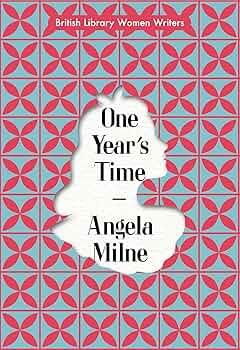
Angela Milne (1909-1990) was the niece of A. A. Milne. She was a regular contributor to Punch magazine. One Year’s Time is her only novel, published in 1942.
Sarah Manvel is the author of the comic novelette YOU RUIN IT WHEN YOU TALK (Open Pen, 2020), and is looking for an agent for her three completed full-length novels. In her spare time, she is a Rotten Tomatoes-approved film critic, primarily for criticsnotebook.com. She lives in London, without a pet, and tweets as @typewritersarah.
 minor literature[s]