

An entire industry of inspirational cure-alls in the vein of The Artist’s Way and other self-help manuals brimming with writing tips has sprung up over the past several decades to try to get writers motivated and moving, to become the writers they’re meant to be. There we can learn the secrets of Hemingway and Balzac. Which nightgown should one wear? Which pen to use? On which full moon? Standing or sitting? Coffee, alcohol? Opium, cocaine? Something stronger?
Or taking the opposite tack: pure stoicism, a Protestant work ethic, or a stiff upper lip to bully one’s body by way of order and discipline in order to complete the task at hand. Schedules must be regimented, goals must be actionable, objectives must be communicated. Thirty pages or no supper. What often results: tortured writing from browbeaten souls.
This kind of creativity manifests more as a type of self-inflicted punishment that all too easily masks Nietzschean resentment and slave morality. For such creativity, perhaps a doctor, a psychoanalyst, would do more good than editor or muse.
Évelyne Grossman takes aim at both defective models in her slim yet potent book The Creativity of the Crisis, translated by Rainer J. Hanshe and published by Contra Mundum Press in 2023. Across three interlocking essays the French philosopher and literary scholar delivers insightful analyses of the various crises of creativity. From the most ordinary and banal, such as writer’s block, to the most profound: the utter desubjectification of artists themselves. If there is no locus in which a crisis of creativity can arise, have we solved that problem once and for all?
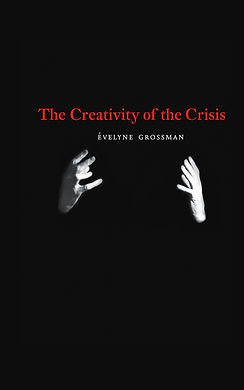
Throughout the first essay, “Crisis of Creativity,” Grossman steers the reader through the vagaries of inspiration in those artistic practices that diagnose writer’s block or blank page syndrome. Though she knowingly retorts that the psycho-medicalized term leucosélophobia belies its own inspired, creative outburst.
She reads this dis-ease across Mallarmé and Artaud, though she rightly articulates that Artaud’s crisis shows itself as something much more than mere lack of creativity or inspiration. Regardless (and even in the case of Artaud), the crisis gets positioned within specific subjects, specific bodies, that in turn become the patients made ill by a lack of motivation. If only I could produce more work. If only I had more time. If only I could better control or submit to my imagination.
Creativity, Grossman points out, is itself typically overcoded with gender, with so-called virility standing erect in the garden of writerly delight. But who engenders this work? In this over-Oedipalized scene, who plays daddy-writer, momma-muse, and little baby-book? She reminds us, though that creation only lazily rhymes with procreation.
In “The Impersonal as a Creator,” Grossman’s second essay, she considers Breton’s 1924 First Surrealist Manifesto as a foundational text in which the murmur springs forth through the process, the medium, of automatic writing. By liberating the “creative energy peculiar to language,” the myth of the lone, solitary (often male) writer-genius can be laid to rest.
In dialogue with Breton, Soupault, Artaud, and Blanchot, Grossman maps resistances to subjectivity, especially to the writing subject (person), demonstrating how Surrealism itself brings about this great shift in the crisis of creativity: “… no longer that of creativity but that which, voluntarily and knowingly fomented, dethrones the creative subject in favor of an irrational and sometimes terrifying outburst of words and images” (41). Creativity then becomes not (merely) accessible to everyone, but rather instead discloses, much like writing in the Blanchovian sense, that very impersonal force at work behind and beneath the creative act, regardless whether or not any one person ever lifts a pen or sits before a blank page.
Under the sway of automatic writing, writing itself deauthorizes the author, sabotaging his/her/their very claim to authority. Who writes when the writing writes itself? Before this rift, Foucault’s author-function no longer functions; Blanchot’s inutility of writing strips the writer of any usefulness, allowing for the work to unwork its magic by appearing fully formed as if from out of thin air.
Not so much the dehumanization of art after the disasters of the twentieth century but rather the reevaluation of the value of the human as subject, as conduit, of writing itself. Barthes’ death of the author writ large, replaced by the unviability of authorship (and authority) as such. Instead of personal, individual writing, what remains: impersonal, singular writing (which, if we follow Grossman’s arc, leads precisely to style as understood by Deleuze).
The space of such literature, of such writing, opens up the space of inter-writing, the open impossibility of writing except as devoid of any one particular writing subjectivity. It is the writing that Deleuze and Guattari expose in the books they coauthor, the writing that appears between Blanchot—whose I always already slips into he—and Foucault (Michel Foucault As I Imagine Him), between Blanchot and Levinas (Infinite Conversation), between Blanchot and Bataille (“Friendship”). That is to say, hesitant, unstable writings (“at once distant & voluptuous”) that “fit together loosely, aggregating or unraveling in provisional and flexible forms that allow us to envision in another way a creation without a defined person” (52).
In the final essay, “Creativity of Crisis,” Grossman discerningly questions, “Should we then cultivate insecurity” (69)? A cultivation intended to suspend balance, to foster destabilization. Perhaps the crisis is this break with reality, “that intimate disaster” that left Artaud the schizophrenic cut off (schizein: “to cut”) from the world as well as from his own mind. Such madnesses abound in literature, in writing: Lautréamont, Poe, Nerval, Hölderlin, Nietzsche, to name but a handful.
Behold: a creative writing that lays the foundation for the stammer, the stutter of Beckett (as well as the slip of Freud), who understood such failure (of communication, of control) as its own creative act. But, as Blanchot might have asked: how to write not so much against failure but rather so as to write in or with the failure of writing? To write writing’s failing? Or rather: to write so as to allow for writing’s failure to write itself?
Grossman deftly—beautifully—weaves together snippets of writing and writers’ lives. Her (and Hanshe’s) vividly expressive prose surges like a wave: at times gentle, at other times forceful. But always compelling. Not the heavy-handed, miserable dialectics or logic of academic philosophy and literary studies, but almost a caress of thinking-through, of thinking deeply. Argumentation by way of undulation that swirls with penetrating analyses, alluring passages, thrilling insights. Rarely have I had such pleasure reading something so rigorous.
Writer and translator Frank Garrett shops in Dallas, Texas, and is essays editor at Minor Literature[s]. His series Better Shopping Through Living will appear (mostly) monthly. He has cultivated insecurity.
 minor literature[s]