

With a life that spanned almost the whole of the twentieth century, Michel Leiris (1901–1990) knew and formed close friendships with many of the most important intellectual and artistic figures of Parisian society, and yet his activities and interests defy simple categorization. Early Surrealist, poet, novelist, essayist, ethnographer, critic, traveller, and art collector, he is best known today as the pioneer of modern confessional literature. Leiris was an astute chronicler of his own lived experience, diurnal and nocturnal, a practice that first found expression with the detailed diary he maintained during the two years he spent as the secretary-archivist of an expedition across sub-Saharan Africa led by anthropologist Marcel Griaule in the early 1930s. This voluminous text is more than a record of travel, meetings, information, and artifact gathering (ethical or otherwise), it is a journal in which Leiris openly included his personal reactions, fascinations, fantasies, dreams, and anxieties as they arose along the way. Published upon his return to France, it holds, in its pages, the seeds of what would become his two primary occupations—ethnography and autobiographical writing. The first activity would have a significant impact on the development of his moral and political views, while the second would become, for him, a vital act of creative expression. The life-long desire to integrate morality and art would then become the driving force behind his sprawling four-volume autobiographical project, The Rules of the Game.
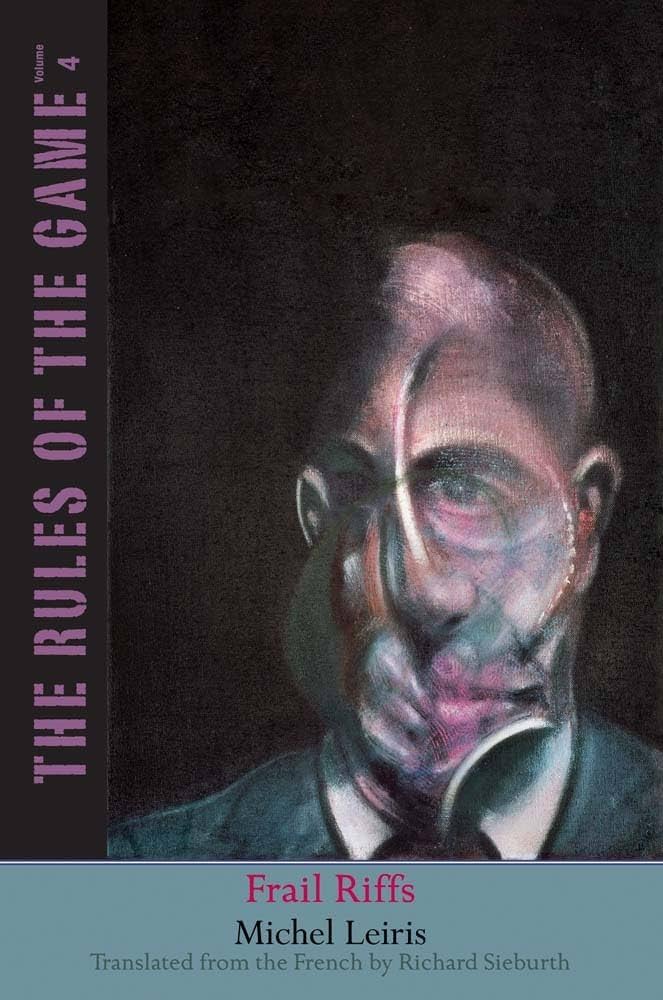
A monumental task that consumed thirty-five years of its author’s life, the comparably monumental task of translating all four books of The Rules of the Game into English has taken almost as long, but now, with the recent release of the fourth volume, Frail Riffs, the last piece of this part of Leiris’ literary legacy is finally in place, even if he would continue to play the autobiographical game for the rest of his life. The first two volumes of La Regle du jeu, I:Biffures (1948) and II:Fourbis (1955), appeared in English in Lydia Davis’ translations, as Scratches and Scraps in 1991 and 1997, respectively. It would however, be another twenty years before III:Fibrilles (1966), again translated by Davis, was published as Fibrils. With the publication of translations of two of Leiris’ other major works—1934’s African journal, L’Afrique fantôme (Phantom Africa) and 1981’s Le ruban au cou d’Olympia (The Ribbon at Olympia’s Throat)—following closely, in 2017 and 2019, anticipation for the final volume of The Rules of the Game has only increased among Leiris’ growing English language audience. Now that it is here, though, Frail Riffs, originally published as Frêle bruits in 1976, sees another experienced Leiris translator, Richard Sieburth, taking over the translation duties just as the style of Leiris’ literary exercise also changes and he adopts the more open, eclectic format that will typify his later works.
The first three volumes of Rules of the Game are characterized by dense, labyrinthian prose, and Proustian wanderings triggered by memories or associations that take him temporarily off course from whatever idea or experience he has set out to explore. His love of language is immediately apparent early on; he delights in the textures of meaning, the sounds of words, and the various subtleties that can be exploited in play as much as in the serious investigation of his collected memories. He is writing to understand himself and as such is careful, with few exceptions, to refrain from speculating on the moods and motivations of others. He speaks only for himself and typically practices great discretion. Although his social circle was peopled with many famous individuals, Leiris’ autobiography is no celebrity tell-all. He mentions few names. Even his own ego is subdued. He dissects his thoughts, actions, and motivations with a clinical honesty and self-deprecating humour that is far more likely to lead to doubt than confidence.
The project was one that grew organically, expanding over time as its author/subject aged and changed, and as his world and his understanding of his place in it was challenged. Leiris is continually, from his earliest literary efforts to his last, writing against death. He was obsessed with his own mortality. ‘Death again, always death again’ is a key leitmotif, one that almost prematurely ends his autobiographical efforts when he downs a stash of medication following a night of drinking and winds up in a coma—an experience that commands central focus in the third volume, Fibrils. This episode, and his efforts to accurately articulate the emotional and physical details of his long recovery, leads him into thinking about the true nature of the activity which has long absorbed so much of his time. Clearly imagining his project as a three-piece set, he is keen to make sense of it all. He claims that he does not see himself as a memoirist reconstructing his life step by step, but as someone who wishes to step outside of time and embrace his life in one sweeping glance. So, as he casts this glance:
over these Scratches, these Scraps, these Fibrils that I am writing not simply in time (in this epoch that is mine and furnishes me my language), but, I may say, with time, since I need long intervals to adjust these materials I have fished from all parts of my life and link to reflections each one of which, far from offering itself in a solid block, is a movement that can be decomposed into several phases. To expect from a discursive, prosaic method the impression of absolute presence and total captivation that can be given only by poetry, in its apparently rootless upwelling, is—of course—to hope for the impossible. . .
Troubled by the way that time necessarily expands between the original experience (or its immediate record in his journal or notes) and the larger autobiographical exercise threatens his desire for authenticity. Ultimately this leads him to lay out the ‘rules’ that he believes should direct the ‘game’ in which he is engaged. Morality is fundamental. His life lived and the ‘poetic life’ that he is writing into being must both be aligned with his moral values, principal of which is to hold to the truth. He thus goes on to list and elaborate on a number of rules he will follow to avoid being untruthful, thoughtless, or indiscreet. But is that it? Is the game solved even if the standards it sets may be unachievable? The later passages of Fibrils imply that this might be the case, but, of course, Leiris has barely packed his manuscript off to his publisher when the stirrings of what will become a fourth volume begin to take shape.
The new book he imagines will be a deliberately hybrid creation that will pull together short essays and prose fragments, reminisces, dreams, travel notes, dairy entries, anecdotes, and ‘pataphysical’ poems into an assemblage that he describes in his journal in late 1966 as: ‘a book that would neither be a private diary nor a formal work of the imagination, neither prose nor poetry, but all this at the same time. A book conceived in such a manner as to constitute an autonomous whole at whatever moments that it might be interrupted, which is to say by death.’
Ah, yes, Leiris was always preparing for his own posthumous literary career. As he gathered material for this final volume of his Rules project, he sorted raw drafts into folders so that he could draw from them without regard to chronological sequence and sort them as desired or, as he says on the very opening page: ‘To lay them down, to move them around, to group them, like cards sorted into a winning combination. To add to them, sometimes to prolong the mosaic, sometimes to plug a gap. To do away with them, in case I (reluctantly) come to realize that the sole remedy lies in amputation.’ At last, the literary ‘game’ he has been playing these many years, has become a game in more than one sense of the word.
The prose piece that Leiris choses to set the tone for the work that will follow across 146 individual entries—the shortest a few lines, the longest forty pages—is a selection from an account dated August 20, 1944. It describes an incident observed from the window of his fourth-floor Paris apartment at 53 bis quai des Grands-Augustins, wherein a German vehicle with a red cross painted on top comes under a hail of sniper bullets and crashes into the window of a shop next door. This event, or rather, his attempt to escape its horror by retreating to the kitchen and running water to dampen the noise, is the mood he wishes to riff against—describing in his journal, Sieburth tells us, as a series of ‘variations’ in the fashion of Bach’s Art of the Fugue or Queneau’s Exercises in Style—in this next, free-structured stage of his autobiographical endeavour.
And, Frail Riffs does not exist in isolation; Leiris is still attempting to stand outside time and take in his entire life in one glance so, although one might read this as a stand alone volume, he is assuming a reader who is also familiar with the key events and themes of the project as whole and, more critically, comfortable with his manner of making often wry, oblique references to certain elements of his life.
The resulting work is one that, even with its more playful elements, comes across as more open and vulnerable. What Leiris can lay bare in an essay that runs only two or three pages long—a common format here—would have otherwise been lost in the swirling eddies of thought flowing through the pages of the first three volumes of Rules of the Game. And by organizing a series of short pieces along thematic lines, he has the freedom to explore a topic in greater depth. It offers a nice balance of short, sharp reflections with extended passages of classically Leiris-style circuitous introspection. And, Frail Riffs does not exist in isolation; Leiris is still attempting to stand outside time and take in his entire life in one glance so, although one might read this as a stand alone volume, he is assuming a reader who is also familiar with the key events and themes of the project as whole and, more critically, comfortable with his manner of making often wry, oblique references to certain elements of his life.
Composed between 1966 and 1976, Leiris is now officially an old man. Although he has routinely complained about age creeping up on him from his forties onward, there is almost an unexpected ease with which he seems to be accepting his eventual fate (which, he can’t know at this point, is still a decent distance away). Retired from his ethnographic career, he still maintains office space at the Museé de l’Homme as a place to retreat to for writing, but Frail Riffs also sees Leiris settling into a quieter, more domestic routine. He and his wife now divide their time between the city and their week-end country home in Saint-Hilaire. And, if earlier volumes featured extensive accounts of work abroad, travel, and the exploration of foreign locales, he now takes great pleasure in strolling through local fields and woods in the company of his dog. He is slowing down.
However, there is still one major excursion which makes an important impression on him—his 1967 trip to Cuba with the Salon de Mai artists’ collective. Although Leiris had become disenchanted with the politics of international communism following his 1955 visit to China, he was inspired by the revolutionary spirit of Castro’s Cuba—not their politics per se, but to the willingness to live up to an ideal and fight for it. This sets off a series of reflections on the nature of Revolution that causes him to question his own degree of commitment to the political causes he passionately believes in:
There are too many disrespected, humiliated people on this globe, a state of affairs that can be remedied only by a radical upheaval impossible without violence. This being the case, I stand behind the revolutionaries. I am of the revolutionary persuasion. Which does not, however prove that I am myself a revolutionary.
Through very honest, critical self-assessment, Leiris captures the essence of the gap between the way we represent the world to ourselves and the way most of us exist in that world. As an avowed anti-colonialist and anti-racist, Leiris is well aware of the inherent contradictions between his ethical and political convictions and his bourgeois life and fondness for bespoke tailoring, not to mention his life-long fear of bodily pain and death. His writing, he decides, is his way of supporting revolution, a compromise which takes him right back to the conundrum at the close of Fibrils: Can one truly reconcile the ethical and the aesthetic in one’s life?
This same tension continues to resurface throughout Frail Riffs as the existential imperative of his endeavour seems to take on a more immediate urgency. His notion of a this final volume as a work in progress that could be cut short without notice, simmers in the background. There is also a sense of the world pressing in more closely—an effect of age, perhaps, and of the increasing presence of television and news media—often leading him to turn back to the grand themes of opera, literature and theatre to guide his reflections and ruminations. He examines the mundane and the marvelous alike. But as ever, Leiris cannot resist turning a critical lens back on himself, even, on occasion, adopting a fanciful third person narrative to offer snatches of auto-fictional (self) portraits. He is at times serious to the point of despair, and at others clearly having fun with puns, witticisms and poetry. Yet, even within this freer, more fragmented format, his commitment to truth is his guiding force:
As a writer, I hope no longer to confuse the white page with the confessional, but it is still to no avail that I try to honor a sentence I once noted down in the hope that it might help me sort things out: Why insist on speaking nothing but the truth when so many things happen merely in the head or heart? But this is not enough to rid me of my mania for truth, of my stern need to be sincere and exact to a fault: so heavy is its purchase on me and so deeply anchored in me are my fears of all the Erinyes-to-come that when I just want to let my pen go its own way, my imagination goes mum, for my heart is not in it.
Unlike many writers who left explicit instructions—more often than not ignored—that their unfinished or unpublished work was to be destroyed upon their death, Leiris was of another mind altogether. He was always organizing and categorizing his notes and drafts so that his executor could see to it that they saw the light of day, along with his personal journal, should he die while a project was still mid-stream. Even if he was inclined to insist, as he does after sketching a modest resume of his professional and personal accomplishments, that the there is ‘nothing, even if I were offered a number of second chances, that would justify my canonization or at least my inclusion in a list of illustrious cases,’ he clearly saw his idiosyncratic autobiographical writings as the legacy he hoped would outlast him. And, so they have. With Frail Riffs, he successfully brought to a close an ambitious decades-long project, but because his writing was both a chosen poetic practice and an ongoing moral exercise, it was inevitable that it would continue. Only death itself would finally put his pen to rest.
Michel Leiris (1901 – 1990) was a profoundly influential and versatile French intellectual and the author of Manhood and Phantom Africa. His four-volume autobiographical essay, The Rules of the Game, serves as a primary document of artistic life in the twentieth century.
Richard Sieburth is professor emeritus of French and comparative literature at New York University.
Joseph Schreiber is a writer based in Calgary, Alberta, Canada. His essays, reviews, and poems have been published in a variety of online journals and print anthologies. He is a former nonfiction editor at 3:AM Magazine and maintains a literary blog called roughghosts.
 minor literature[s]