

These days I don’t often read short story collections. My preference for fiction is the long form, either novellas or novels, where the ephemeral inhabitation of narrative and characters is less finite. Although there are single short stories I will read with some frequency when they appear in journals or online––especially if they are by authors who have mastered the form (Benjanun Sriduangkaew leaps to mind)––I tend to avoid short story collections. Committing myself to a book of starts and stops, a sequence of micro-inhabitations where I’m jolted out of each universe just when I was beginning to appreciate its logics, feels like having to make multiple commitments over and over. A series of ruptures upon my concentration. I’m not claiming that there is anything objectively wrong about this aesthetic experience; my preference in this regard is likely the result of my learning disability and how my reading habits have developed in compensation for this disability. Which is to say that, while I frequently read short stories by themselves, I infrequently read short story collections. The last short story collection I read was Brian Evenson’s Song for the Unravelling of the World in 2020. Before that, I cannot recall: it may have been something as old as a Thomas Ligotti or Angela Carter collection or a sporadic return to a Borges collection, I’m not sure.
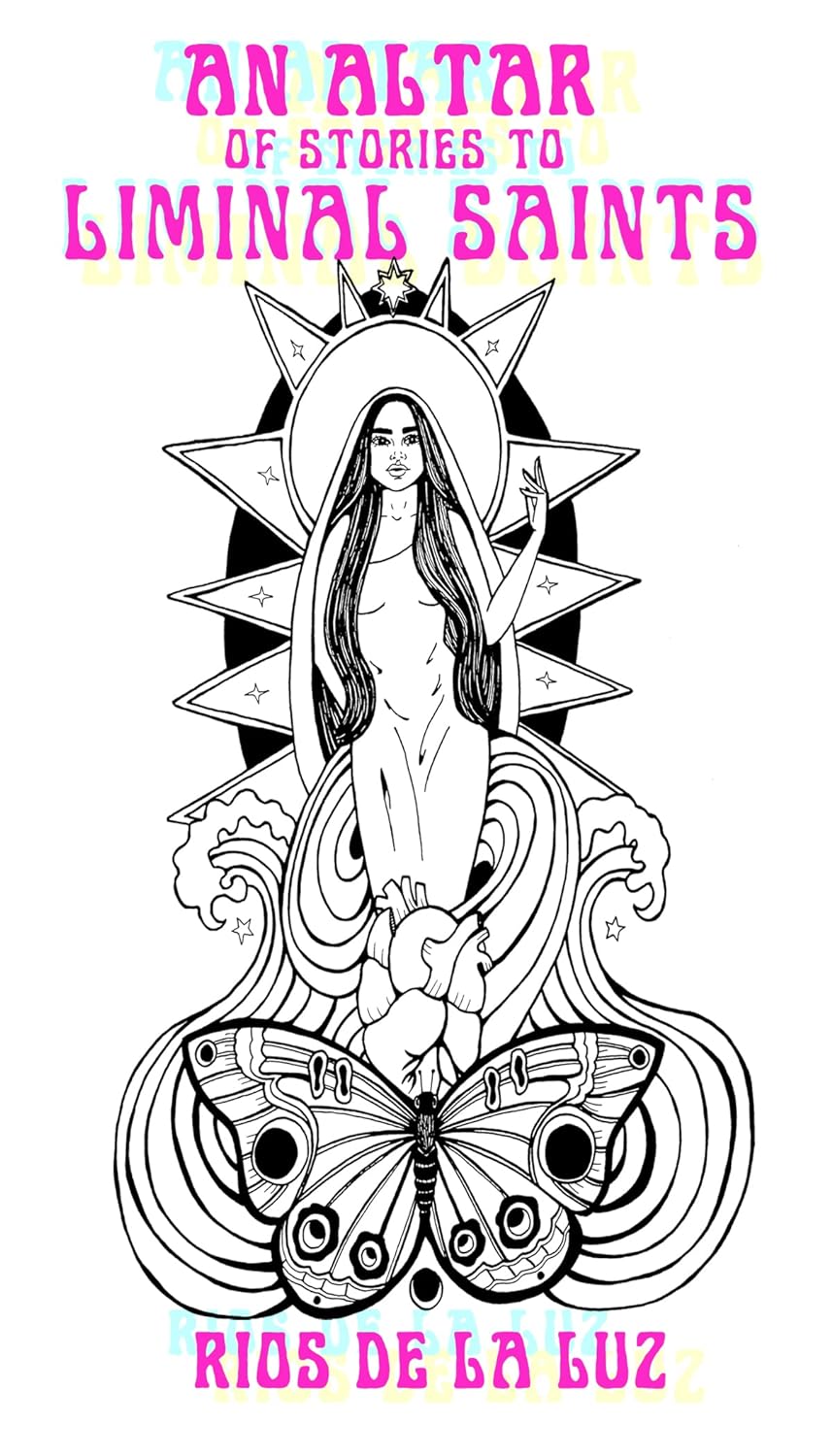
What I’m trying to say here is that I wouldn’t normally care about reading, let alone reviewing, a short story collection. But Rios de la Luz’s An Altar of Stories to Liminal Saints was an exceptional case. I encountered de la Luz’s novella, Itzá, years after it was published and was impressed by the singularity of her voice. When I learned that her next publication was a short story collection, because of my love of her novella my normal antipathy for this medium dissolved in the excitement of reading something from the author who had generated one of the most brilliant literary horror novellas in the past five years. Although I experienced some of the problems of the short story collection I discussed above, I had to force myself not to move through this series of stories at a manic pace. Despite the narrative ruptures, it invited continuous engagement; I worked hard to stretch out the experience by pacing myself and cherishing each story.
An Altar of Stories to Liminal Saints occupies the same genre world(s) as the collections I mentioned above––Carter, Ligotti, Evenson, Borges––which is to say somewhere in the imbrications of literary horror, weird fiction, and magical realism. In Itzá there were supernatural horror and magical realist elements, but these were largely subordinated to a realist façade and only allowed to spill from the margins to the centre at key points in the narrative. In most of the stories in this collection, though, de la Luz glories in these genre elements, pushing them to their surreal limits. (Such an approach to genre runs parallel to Andrew J. Stone’s All Hail The House Gods and The Mortuary Monster where the rules of horror and fantasy are subordinated to a dream-like logic.) A story about a town determined by warring cults devoted to an interdimensional rift that explodes people who get too close, complete with ritually murdered corpses––one of which returns to life and transforms into a flying, goat-hooved, vampiric monster. A story about an exorcism where the Priest is compromised by a demonic entity that encourages him to steal children and take them to an otherworldly temple in the woods, where the “possessed” child might also be her mother, and where the violence behind this possession is located in an abusive figure within whom are a series of photographs. The tiny weird universes of each story tend to sweep you up in their internal logic, laid out in de la Luz’s elegant and immediate prose.
But there is also an organic element that ties the collection’s stories together. The grounding of subjectivity in bodily organs and the surrounding earth or sea, the relation of the body to nature, is a dominant theme in this collection. “Only the dirt will save us,” a character proclaims in the second story to a weary protagonist who can only shrug and respond “Probably.” (13) As with Itzá, the author is also concerned with various and interrelated forms of social violence––gendered violence, racist violence, border violence––and she often ties these manifestations of quotidian horror to supernatural horror. But this tying together does not equate the two manifestations of horror as symmetrical; a constant repetition in de la Luz’s work is that the former is more horrific than the latter. That is, the everyday horror of social violence is often described as far worse than any manifestation of supernatural horror. When the latter is truly repugnant it is because it intersects with the former. In other cases, supernatural horror is used by de la Luz as a panacea for the horror of the everyday. Such a panacea is found in the earth, and also the sea, as a chthonic witness or response to human engineered horror.
The collection’s first story, “Dirt”, is about a man who is addicted to eating dirt. Upon accidentally eating the earth as a child, he develops an appetite for dirt. “Ignacio swallowed the dirt and became dizzy with ecstasy. The dirt made him see stars… he could taste the entire season of summer in his mouth.” (1) Although he experiments with other organic matter (“tree bark, moss, dragonfly wings, tiny pebbles”), Ignacio is only able to experience “divine nutrition” with dirt. At some point before becoming an adult, Ignacio wanted to become an archaeologist so he could “taste the bones of dinosaurs with a dash of meteor dust and the destruction of prior empires. He had tasted massacre and war. War dirt was bitter and made his belly bloat.” (2) But like most born to racialized poverty under US capitalism, he cannot realize these dreams and instead becomes a construction worker. Eating construction dirt as opposed to archaeological dirt parallels the settling for the former type of excavation over the latter. Although de la Luz could have continued to examine the weird horror of this dirt eater, the story transforms quickly into a story about the daughter, Luna, he leaves behind while on a migratory construction job, a child he has to hide from another family out of state, and the literal giant heart he leaves for her––a heart his dirt-eating generates from his body––pulsing and sentient in her backyard. A weird organ generated from the compulsion of literal communion with the earth; the body’s grounding and dislocation in nature itself. A heart, born of the earth, that “asks to see the ocean” (8)––and this theme of earth and ocean, connected by bodily matter, will appear frequently in the following stories.
The wretched of the earth, deprived of any form of subsistence economy, would resort to eating the dirt for nutrients––they were even punished for such attempts to fill their bellies. This was the barest form of subsistence by subaltern life, rendered transgressive by those who would prefer that such life simply die off rather than perpetuate their existence even in the most impoverished practice.
The convention of dirt-eating shows up in other stories in the collection; this is not an accident. In Open Veins of Latin America Eduardo Galeano talks about how this convention was common amongst the colonized and enslaved. The wretched of the earth, deprived of any form of subsistence economy, would resort to eating the dirt for nutrients––they were even punished for such attempts to fill their bellies. This was the barest form of subsistence by subaltern life, rendered transgressive by those who would prefer that such life simply die off rather than perpetuate their existence even in the most impoverished practice. Those who came from across the ocean, those who washed up on the shores of the Americas so as to subordinate bodies and organs to their order.
The eponymous “An Altar of Stories to Liminal Saints” is a kind of fantasy response to the order of Conquest, in a micro-organic manner. This story concerns a series of parcels left at the door of Yvette, a middle-aged woman. The first parcel, labelled for Yvette, results in a call from her dead mother. She is encouraged to distribute the other parcels to their addresses, each one a miracle for successive protagonists––women, children, and even a racoon––dealing with various forms of oppression and immiseration. Most require contact with the earth, demands to engage in chthonic exchanges that often have to do with bodily organs: “She opened the box and a human heart with a white ribbon tied around it continued to thump. A note from sender stated BOIL ME. BURY ME IN LOCUST GROVE CEMETERY.” (22) The flash fictions within the larger short story provide glimpses of terribly compromised lives that eventually find stability and meaning through the intervention of this fantastic potlatch. And this is all a magic realist dream, a demand by the author that there ought to be something––in the earth, in the scaffolding of reality––that responds to all the pain and suffering of the oppressed. To hope that the earth can respond to the suffering of its wretched is indeed fictional: “Yvette kisses Regina on the forehead and then her lips, they lean into each other as they watch their nightly telenovelas where the main characters are guaranteed to find love and happiness.” (45)
In “The Mermaid” a child, Mayra, is watched over by a mermaid who initially wants to eat her but instead chooses to devour her predator after sensing Mayra’s pleas for help. The sea, like the earth, becomes a force that drags the predatorial figure into its depths. Another chthonic levelling, but only a reminder of possibilities. The mermaid “hoped the sea would remind the girl that sometimes bad men drown and that’s the most justice the world will give.” (79) In the end this imaginary justice of the earth is not enough; the appeal to these chthonic forces is only a sometimes, at most a lex talionis gesturing towards a better world that only the actions of the human characters can bring into being according to their hopes and desires. Hopes and desires that are stymied, despite this theme of the earth’s supposed justice, by their flawed actions and aspirations.
As Raquel and Anaya are stymied by cults and an interdimensional rift in “Cosmos, Oklahoma”, or as Estela and Alejandra are forced to navigate the demonic boundaries drawn by the Priest and his town in “Morning of the Teeth”––the final and most gripping stories. The earth is not enough. In the former story, Anaya is annihilated by interdimensional chthonic forces; Raquel continues to party with her cult despite this, refusing to think the meaning of its dogma. In the latter, the earth is rendered sinister by a Priest who sacrifices children to a forest temple where “soggy mud drenched their white robes, and hands from under the earth grabbed at their feet and hair.” (98) The earth is not so caring after all, or at the very least it is haunted or compromised by the priestly avatars of the Conquest.
As with every short story collection, the possibility of review is stymied by the fact that the reviewer is forced to find a common thread to unify a disparate collection of narratives. Perhaps such a unity is never possible; the best approach is to find a line of march that can chart its way through such narratives. Maybe I haven’t found the perfect line of march through de la Luz’s collection but I hope I’ve found one that has been illuminating. Because as we march through the collection’s stories we encounter these appeals to the earth as a ground of being in response to the multiple forms of violence that characterize life under the capitalist world system. That is, de la Luz’s appeals are akin to Antigone’s appeals to similar chthonic forces. Indeed, there is something resembling Antigone’s confrontation with Creon that underlies An Altar of Stories to Liminal Saints: the desire, in each and every story, that the perspective of women––especially those women who care about other women and children––is treasured over the sanctimoniously legal actions of cis heterosexual men. In the story “Tame the Coyotes”, for example, an entire community of women who have learned to tie themselves to the earth––as Antigone tied herself to the chthonic order––also must learn to render themselves invisible to the legal system of patriarchal intervention. “When the men with guns passed by, the women claimed they heard nothing. The women became so good at lying, the men started to question whether they heard anything at all.” (71)
At the same time, however, such appeals to the earth can echo Carl Schmitt’s reactionary claims in The Nomos of the Earth that locates the origins of law in the fascist notion of blood and soil. This fascistic claim to nature is represented, as aforementioned, in the final story where a Priest is in commune with an oppressive earth––with the blood and soil into which he leads child sacrifices. But as a priest, he represents the Conquest and thus the way in which the earth has been claimed and renamed by the protagonists of Schmitt’s conception of reality, those who occult the earth so as to draw borders and conquer. Conquistadors and priests. Against this conception of the earth, de la Luz appeals to the thought of the subaltern and oppressed seeking a better understanding of forms of life prior to such colonial and fascistic claims on nature. An Altar of Stories to Liminal Saints is ultimately about the hope for a better earth achieved through a levelling of accounts. Hoping that the earth and sea will respond to the everyday violence of patriarchy and colonialism, translating this hope through fiction. And these stories are exactly that: moments of hoping that the entire earth will make a better world and that we can think such a world once the earth has settled.
Rios de la Luz is a writer/creative living in Oklahoma with her son and her love. Her short story collection, The Pulse between Dimensions and the Desert, was published via Ladybox Books. Her debut novella, ITZÁ is available via Broken River Books. Her work has been featured in Vol. 1 Brooklyn, Entropy, Luna Luna Magazine, Broadly, The Fem Lit Magazine, St. Sucia and Corporeal Clamor. Rios is a queer weirdo and a proud Xicana/Guatemalteca. An Altar of Stories to Liminal Saints was published by Broken River Books in 2023.
J. Moufawad-Paul lives in Toronto, where he works as a professor of philosophy at York University. He is the author of Continuity and Rupture, Politics In Command, Demarcation and Demystification, and other books.
 minor literature[s]