
Róbert Gál’s Tractatus offers an epigraph by the Austrian philosopher Ludwig Wittgenstein: “Philosophy ought to be written only as poetry.” Gál certainly takes those words to heart as he effectively uses them for guidance to fashion a compendium of wry philosophical speculation and unclassifiable blank verse.
Formally, Tractatus is a collection of numbered sections, each ranging in length from a single sentence to a dense paragraph. The numbers attached to each section suggest thematic, possibly propositional connections, though they more often seem to be poetic associations than strictly logical ones. No matter: instead, proceed by following the sections according to their connection to that of the aphorism. For it is the aphorism that is a brief concentrated insight or analysis, idea or interpretation, that often confounds the reader. And the best aphorisms often feel like a punch to the head, where one suddenly encounters the Self in a condition of vertiginous disequilibrium. Whether one agrees or disagrees with an aphorism is beside the point: its purpose has been met if thinking has been stirred. Gál’s Tractatus – which might owe more to Cioran than Wittgenstein, and certainly more to later Wittgenstein than earlier – is all about stirring up the settled mind.
Gál begins:
1.1 I don’t remember the day I died, but it was obviously before I’d had time to be born. And nothing had mattered more to me than that very business of getting myself born. Ideally getting myself born into the me that had been born already […]. Born into the ready and waiting, hence painlessly. Not being born, though born already. But what into? Shall we imagine it?
This is nearly the start of a folktale. The voice almost a spirit-being, other worldly but seemingly animate. Gál’s narrator speaks to us after birth about the condition of his previous death, which he does not remember. The conflict between death and being born into life is established. The forgetting of one’s death is necessary, it would seem, so that one can be born “into the ready and waiting, hence painlessly” condition of life. Of course, Gál continues, we don’t really know what we are born into, do we, not really, but we can imagine it.
Like any aphorist, Gál prefers to range widely in subject matter. He concentrates briefly, then moves on. The aphorism does not readily lend itself to extension, rather it prefers to focus and drill downwards within strict limits of time and space. (The aphorism might be considered the perfect literary form for the philosopher who also happens – metaphorically – to be fugitive.) So Gál touches upon psychology as a place of conflict where higher and lower meet, the better self and the worse self contend:
1.3 A better self and a worse self are fighting about which of them is the better. The better self’s defense is the distance it can cover in the blink of an eye. The worse self is consistently located at its own center, which it is sometimes apt to shift à la Machiavelli. Its essence remains unaltered […].
The better self has the ability to flee. “In the blink of an eye.” The worse self, contrary to what we might expect, is fully centered, unchanging in its essence, though its outward allegiances might shift, in accordance with ruthless political or corporate, or other banal, expediencies.
The philosopher often regards the poet suspiciously. The logician regards the poetic statement as having little truth value, as more shadow than substance. For the aphorist, however, there can be fine alignments between poet and philosopher, so that it is easy to appreciate how the efforts of the former are replicated by those of the latter. Here we have Gál describing the plight of the philosopher, but he could just as easily be describing the plight of the poet:
1.32 Regularly launching balloons from one’s ivory tower with messages attached and making passersby first catch them and then decipher them.
It is a fanciful image, but certainly just as applicable to the likes of the poets E.E. Cummings or Louis Zukofsky as, say, the philosophers W. V. O. Quine or Slavoj Žižek. Poets might not like what a passerby might conclude, but would most likely accept it as valid, for that person. A philosopher, on the other hand, might not be as generous in allowing a misinterpretation its place in the sun.
Over the course of this brief and thronging text, Gál explores numerous subjects. He considers human understanding; authenticity; appropriation of language -; he ponders existence; time; blindness; the possibility of forming judgments; the nature of truth, falsehood -; he thinks about terror; frivolity; the limits of intelligibility; intelligence; continuity -; he meditates on the penalty for joy; form as content; the quest for perfection; silence; music; story; space; he considers faith; belief; hope; memory; non-existence; pathos; the law of gravity; the purpose of philosophy -; and on and on. To say that, Tractatus ranges widely is merely the taking of the book’s vital signs: it must be said because they must be taken.
Of course, particulars are illustrative:
1.82 […] Flesh out the apparently logical with the impulse to want and instantly want becomes must have. A kind of analogue to the process of murder.
In the popular understanding, logic is opposed to emotion: mathematics, chess, the business ledger are occasions where logic provides the foundation for action. In the realm of the popular imagination, logic is often linked to a pitilessness that can easily reduce logic to an ‘analogue to the process of murder.’ Yet Gál later suggests an alternative analogue when he redefines logic thus:
9. 2 Logic is when ‘want to’ falls in love with ‘must’.
This definition is an older definition, one animated by pre-mathematical, pre-scientific sympathies, suggesting mysteries and original animating energies, forces that would contend and balance and shape the universe itself. The first character Want To falls in love with Must. Together they give birth to Logic.
Occasionally, Gál seems to combine philosophy and psychology, following the practice of novelists and poets. Such sections read like anguished entries from some private notebooks:
3.13 My abysses defy comprehension. Try looking into them for more than a minute – then you’ll comprehend. Maybe you’ll hit the bottom. When the boomerang of your impact comes back to the spot from which the threads on which you stand have been perfidiously spun, you may hit the living, jelly-like matter of a spider, your creator.
Yet the reader is still challenged, still prodded towards self-reflection and confrontation with the self and that ‘jelly-like matter of a spider, [our] creator.’
At other times, Gál resorts to story, using familiars drawn from ancient lore. In this case, the rat and the tortoise combine in a grisly school-boy variant of an Aesop fable:
7.2 He recalls his classmate at middle school chasing a limping rat around the yard, the lad himself limping and clutching a brick. The rat had taken refuge under a car. More classmates ran up to try to lure the rat to another spot. The rat wondered what to do. It poked its head out, then, slowly, its whole body. It has no inkling of the danger directly above it. And down came the brick – the rat’s entrails spurted out. Years later, his classmate bought a tortoise so that, having its own armor plating, it would be protected against the kind of which he, too, was one. When it went and died on him, he promptly decided that he, too, would depart this world, and he shot himself.
Of course, the conclusion is more Kafka than Aesop in keeping with Gál’s own dark 21st century sympathies.
This book is abundantly allusive. Obviously, Wittgenstein casts his shadow, but Cioran’s presence is perhaps even more substantial. Kafka has been suggested to lurk in corners. Additional cases might be made for Maurice Blanchot, Georges Bataille, even Jerzy Kosiński. Machiavelli and John Cage are both present in certain sections. And Samuel Beckett’s influence can be distinctly sensed in the following:
9.1 Waiting always entails an element of irony, which is best appreciated when that upon which we are waiting persists in not coming.
Indeed, Beckett’s most well-known play is all about characters who wait and wait for another character named Godot, who persists in not coming in the first Act and then not coming again in the second Act.
Finally, it is impossible not to recall Heidegger and his discussion of Van Gogh’s painting “A Pair of Shoes” when one reads the following section, where Gál considers experiencing a familiar painting in a suddenly new way, as if for the first time:
4.1 […] Imagine, say, a picture, which, leant back against a wall for years, has never said anything to us, then out of the blue it takes the floor to recount the story depicted in it. A story to which we have so far been blind, because it has been part of another story being played out inside us, and we have laid claim to it, resolved to lay such a claim. But suddenly something snaps. Our resolve fails. A previously unknown story starts speaking in its own tongue, which we instantly understand. At that moment we are ready to accept its message, pick the picture up and place it somewhere where it will stand guard over our dream of an encounter between miracle and resolve.
I’m not suggesting Gál is merely providing us an instance of Heideggerian analysis, rather that he is offering his own unique perspective filtered through the philosophical urgency of an aphoristic mode that bears upon what has gone before.
From start to finish Gál’s book challenges us; it asks us to think:
27 The purpose of philosophy is not to give us ideas but to teach us to think.
And this is precisely what this brief, dense, sly, challenging, evocative book by Róbert Gál does; most ably and seamlessly translated from the Slovak by David Short. It comes highly recommended.
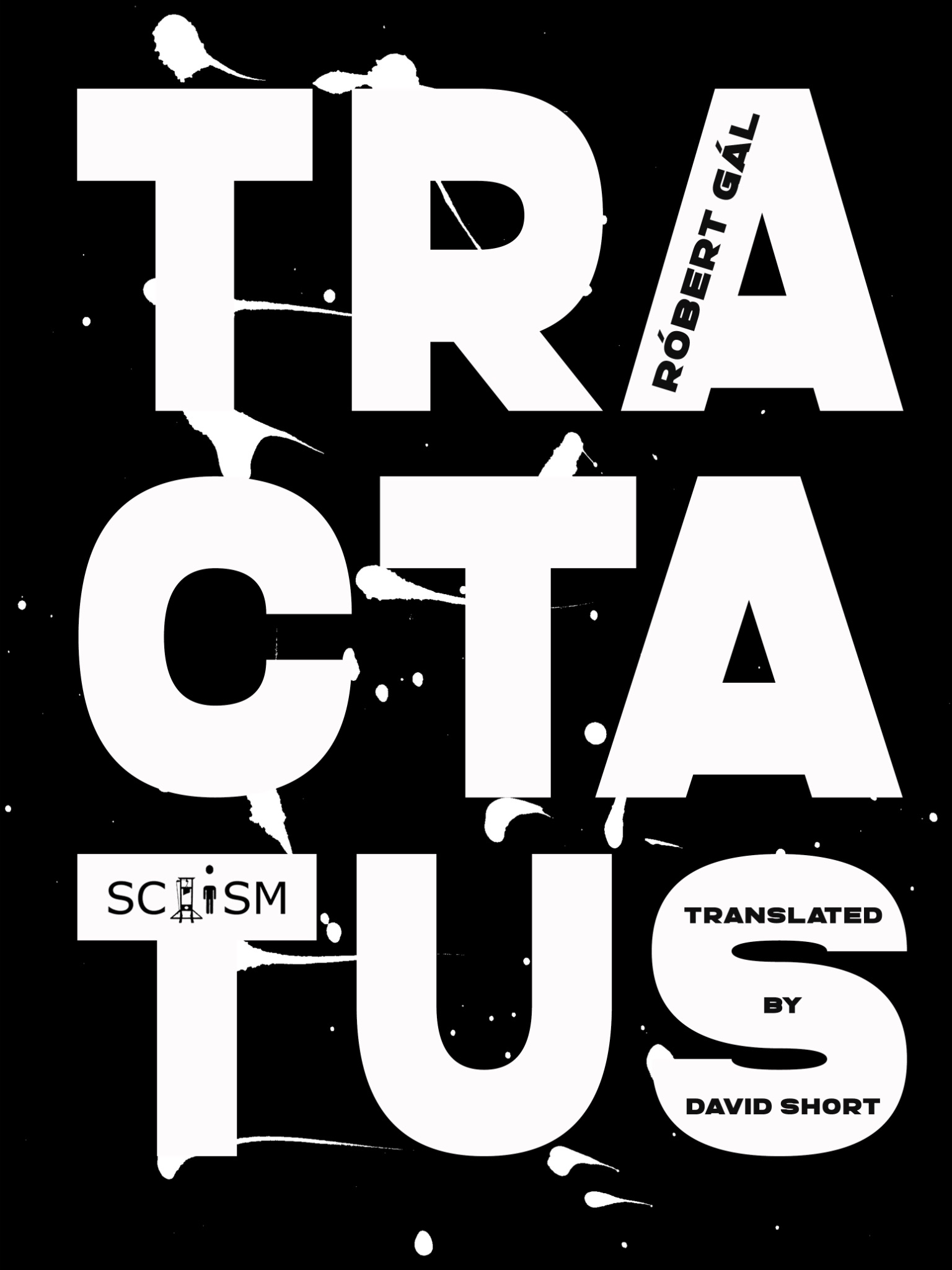
Róbert Gál is a Slovak-born writer and editor living in Prague. He is the author of several books of aphorisms, fiction, and philosophical fragments available in English translation, including Tractatus (Schism Press, 2022), Naked Thoughts (Black Sun Lit, 2019), Agnomia (Dalkey Archive Press, 2018), On Wing (Dalkey Archive Press, 2015), and Signs & Symptoms (Twisted Spoon Press, 2003). Twitter: @Tractatus2022
David Short taught Czech and Slovak at the School of Slavonic and East European Studies, University College London, from 1973 to 2011. He has written and published widely on Czech language and literature, less so on Slovak. His published translations have been both academic and literary, among the latter (whole, or extracts from) works by such Czech classics as Karel Čapek, Jaroslav Durych, František Gellner, Jaroslav Hašek, Bohumil Hrabal, Vítězslav Nezval, Gabriela Preissová, and Jaroslav Seifert, and by established modern writers such as Hana Andronikova, Antonín Bajaja, Daniela Hodrová, Karel Michal, Jáchym Topol, and Michal Viewegh.
Jon Cone is a Canadian poet, playwright, writer, and editor who lives in Iowa. He has an MFA from Vermont College of Fine Arts. His recent works include New Year Begun: Selected Poems (Subpress Editions: Brooklyn, NY, 2022); Liminal: Shadow Agent, pts 1 and 2 (Greying Ghost, Salem, MA, 2022); and Cold House (espresso, Toronto, Ont., 2017). With Rauan Klassnik, he wrote a collection of plays, An Ice Cream Truck Stalled at the Bottom of the World (Plays Inverse, Pittsburgh, PA 2020). For eight years he edited the literary review World Letter. Several years ago, he provided additional vocals in the recording sessions for Uruguayan poet Luis Bravo and the American experimental poet John M. Bennett. Twitter: @JonCone
 minor literature[s]